


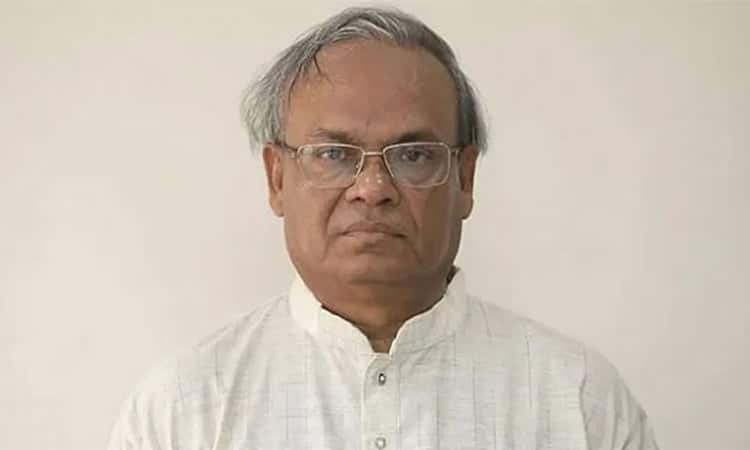
Referring to former prime minister Sheikh Hasina, Ruhul Kabir Rizvi, acting secretary general of the Bangladesh Nationalist Party (BNP) and political adviser to the prime minister, has said that those who did not hesitate to drink the blood of the country’s own children will never be able to fly back and settle in again, and the people will never accept it.
He made the remarks as chief guest at a discussion meeting organised by the Bangladesh Jatiyatabadi Chhatra Dal on the occasion of the historic National Revolution and Solidarity Day. The event was held on Sunday (8 November) afternoon at the auditorium of the Teacher-Student Centre (TSC) of Dhaka University.
Rizvi said, “The person who ruled the country so ruthlessly and cruelly after shedding so much blood and carrying out so much oppression is now saying she will return to the country in December. But the fresh faces of those children, teenagers and young people who took bullets in their chests are still floating before the eyes of the people of this country. Can the glorious mass uprising that took place through their sacrifice be erased? Can the sacrifices of Abu Sayeed, Mugdho and Wasim Akram be wiped out?”
Referring to Sheikh Hasina’s plan to return home, he added, “Will Sheikh Hasina suddenly descend by parachute and everyone will welcome her with drums? Is that ever possible? The soil of Bengal is the soil of heroes. This soil has given birth to many heroes. Those who shed the blood of their own country’s people and fled the country cannot simply fly back and settle in, and the people will never accept it. That will never be possible.”
Sheikh Hasina, for her part, has repeatedly expressed her firm resolve to return to Bangladesh, face any legal proceedings in the country’s courts, and has demanded that the ban on the Awami League be lifted so that the party can participate in the political process.
Highlighting the connection between the July 2024 mass uprising and the spirit of 7 November, Rizvi said the accumulated anger of the people found expression in the July uprising, whose spirit was the same as that of 7 November. He asserted that no one would be able to control this country of 180 million people, no matter how hard hegemonic forces and their local agents tried, and Bangladesh would never be brought under the claws of hegemony.
On the significance of November, he said 7 November was not only the beginning of the journey of multi-party democracy and the securing of democratic rights, but also the start of formulating a foreign policy and internal policies free from foreign influence and of taking decisions independently. With whom Bangladesh would maintain friendship or enmity, or with whom it would sign agreements, was the exclusive matter of the Bangladesh government and people, and would not be dictated by anyone’s orders, gestures or words.
Recalling the long obstruction in observing the day, Rizvi noted that due to 17 years of fascist rule it had not been possible to observe National Revolution and Solidarity Day properly. The day had been observed officially since 1976, but during Sheikh Hasina’s rule it was not allowed to be observed officially for 17 long years. However, various organisations continued to observe it socially and politically, so the significance and underlying spirit of 7 November were never erased.
Referring to the past struggles of Chhatra Dal at Dhaka University, he said the organisation had tried to enter the campus many times, was beaten and driven back, returned again, was beaten again and driven back again. But the attacks on Chhatra Dal leaders and workers and the blood that flowed from their bodies never went in vain. People across the country observed these incidents, and the blood that was shed created a spirit of protest and resistance among many young people and ordinary citizens of the country.
Highlighting the contribution of martyred President Ziaur Rahman, Rizvi said he wanted to build a skilled and efficient army and did not want the army to be politicised. Today’s modern army is the contribution of Ziaur Rahman.
Praising the current leadership of the party, he said that despite hundreds of attacks and threats, Tarique Rahman was steering the country and guiding the party on the right path even in the midst of a turbulent sea. He described 7 November as a compass that shows the correct path even in times of danger.
The meeting was presided over by Chhatra Dal central president Rakibul Islam Rakib and conducted by its general secretary Nasir Uddin Nasir. Rakibul Islam Rakib said that through the united revolution of the soldiers and the people on 7 November 1975, the independence and sovereignty of Bangladesh had been protected. It had not been possible to observe National Revolution and Solidarity Day properly for the past 17 and a half years, but the entire nation had celebrated the day unitedly the previous day.