


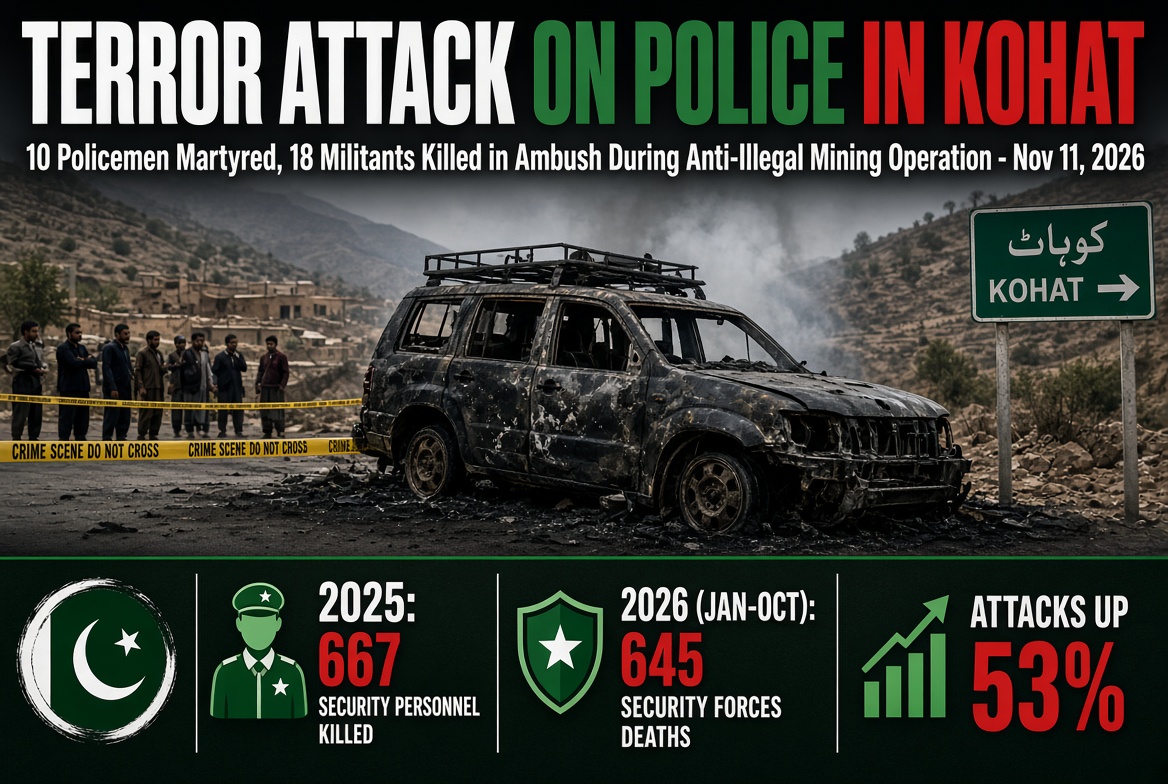
At least 10 Pakistani police personnel, including a deputy superintendent, were killed and 18 militants eliminated in an ambush in Kohat district, Khyber Pakhtunkhwa, during an operation against illegal gold mining on Wedn.
Khyber Pakhtunkhwa Police stated that officers and the local civil administration carried out an operation against illegal gold mining in the Darabokach (also reported as Darbukach/Darbukach Jalandhar Banda) area near Kohat, within Gumbat police station limits and near the Kohat-Karak boundary.
After the operation concluded, the returning police contingent was attacked by militants the authorities describe as Fitna al-Khawarij (a term used for Tehreek-e-Taliban Pakistan-linked fighters) acting at the behest of criminal elements involved in the illegal mining.
Police said the officers fought back with “exceptional courage and bravery,” killing 18 attackers. Ten KP Police personnel were martyred in the encounter, including Deputy Superintendent of Police (DSP) Haider/Haidar Zaman of Gumbat and a sub-inspector. Several police vehicles were set on fire. Early reports, including from Reuters citing a rescue group, put the feared police death toll at 11; other accounts varied between eight and 11 killed with roughly 12 injured as details emerged.
Rescue 1122 teams treated the wounded, and an emergency was declared at the District Headquarters Hospital in Kohat. No group immediately claimed responsibility in the initial reporting, though the pattern matches TTP activity in the province.
KP Police highlighted what they called an organized nexus between criminal mafias and the militants, operating with external support, and said facilitators would not be spared. Reinforcements and clearance operations followed.
Broader pattern of high security-force casualties
The Kohat attack fits a sustained wave of armed assaults that have made Pakistani police and army personnel primary targets, especially in Khyber Pakhtunkhwa and Balochistan.
According to the Pakistan Institute for Conflict and Security Studies (PICSS):
- In 2025, combat-related deaths reached approximately 3,387–3,413 (up roughly 73–75% from 2024). Security forces personnel accounted for 664–667 of those deaths—the highest annual toll since 2011—alongside more than 2,100 militants and about 580 civilians. One detailed accounting noted roughly 216 police and 374 Army/Frontier Corps fatalities that year. Militant attacks numbered over 1,000, the highest annual total since 2014, with increased use of suicide bombings and drones.
- In the first 10 months of 2026, PICSS recorded 1,376 militant attacks (up 53% compared with the same period in 2025). Combined deaths from attacks and security operations reached 3,902, including 645 security forces personnel, 595 civilians and nearly 2,600 militants. Attacks and overall lethality remained elevated despite a sharp month-on-month drop in October.
A separate Pakistan Institute of Peace Studies (PIPS) report for 2025 counted 699 terrorist attacks (up 34%) and 437 security personnel killed (174 police, 122 army, 107 Frontier Corps). The Tehreek-e-Taliban Pakistan (TTP) and allied groups have been the main perpetrators in Khyber Pakhtunkhwa, with Pakistan repeatedly accusing Afghan territory of providing sanctuary—an allegation Kabul denies. Violence has concentrated in southern KP districts such as Bannu, Lakki Marwat, Tank and Kohat, as well as former tribal areas, with frequent ambushes on police convoys, checkpoints and operations against criminal activity.
Recent monthly snapshots underscore the pressure: July 2026 was particularly deadly for security forces (over 100 killed in one month according to PICSS), while a rolling 30-day window into mid-November still showed dozens of security personnel killed nationwide. Overall, security forces have remained the primary targets even as their own operations have inflicted heavy militant losses.
The Kohat incident, linked to both illegal mining and militant ambush, illustrates the overlapping criminal-militant threat that has driven elevated police and army casualties across Pakistan’s northwest in 2025–2026.