


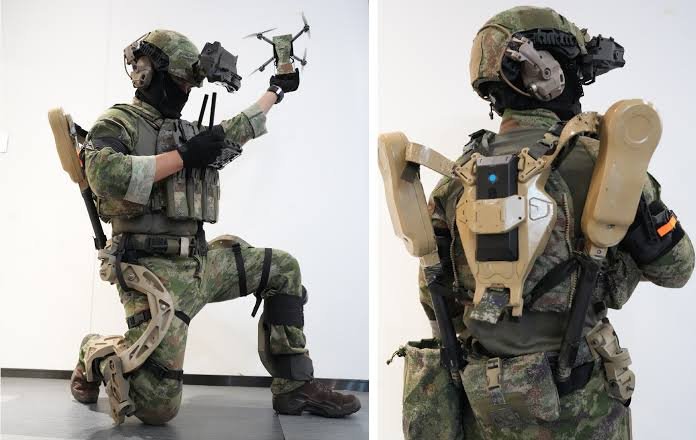
Analysts have outlined Chinese strategic objectives in any potential renewed conflict involving Pakistan against India—referred to as “Sindoor 2.”
They say Beijing seeks real-world combat data on emerging technologies by leveraging Pakistani forces.
The X account (@NepCorres), which describes itself as a platform for investigative journalism and analysis, lists three main goals:
- Exoskeleton testing: China intends to evaluate the real-time performance of its exoskeleton gear through Pakistani infantry. Linked cameras, sensors, and drones would collect battle data to refine futuristic AI models for the People’s Liberation Army (PLA). It notes that current PLA equipment has largely been developed on hypotheses without realistic combat exposure.
- Air defence upgrades: Following what it calls the “shameful failure” of HQ-9 and HQ-16 systems during Operation Sindoor (the May 2025 India-Pakistan conflict), China has upgraded the systems and plans to retest the improved versions.
- BeiDou satellite and drone integration: The BeiDou navigation system, refined during Iran-related conflicts for missile guidance, would be tested with Turkish drones. Success would give China a battle-tested, integrated package to compete more effectively against Western (especially American) defence offerings. The thread concludes that the Pakistani Army functions essentially as a “mercenary force” for China.
These assertions are analytical and predictive rather than based on official Chinese or Pakistani statements. They fit a broader pattern of commentary on the China-Pakistan partnership but require independent verification.
Broader Context: Operation Sindoor and Chinese Support
Operation Sindoor followed a major terrorist attack in Pahalgam, Jammu and Kashmir, in April 2025 that killed 26 civilians. India launched strikes on terrorist infrastructure in Pakistan and Pakistan-administered Kashmir.
Pakistan responded, and Chinese-origin systems—including J-10C fighters, PL-15 missiles, and HQ-9/HQ-16 air defence systems—saw combat use.
Multiple reports from Indian and some independent sources indicated underperformance by Chinese air defence systems, with Indian strikes (including BrahMos and SCALP missiles) penetrating Pakistani defences. India later highlighted the effectiveness of its indigenous systems such as Akashteer.
China later acknowledged providing on-site technical support. State media interviews with engineers from the Aviation Industry Corporation of China (AVIC) described work at Pakistani airbases supporting Chinese-made aircraft during the four-day conflict.
Indian officials, including the Deputy Chief of Army Staff, described the episode as a “live lab” in which China tested systems via Pakistan while remaining largely in the shadows, using Pakistan as a “pressure valve” or “borrowed knife.” Reports also cited Chinese satellite/ISR support enhancing Pakistani situational awareness.
Stockholm International Peace Research Institute (SIPRI) data shows China supplied roughly 80% of Pakistan’s major arms imports in 2021–25 (up from about 73% previously), accounting for a large share of China’s own exports. Key systems include J-10C and JF-17 fighters, frigates, submarines, HQ-series air defence, and drones.
Recent Military Cooperation and Technology Developments
In October 2026, China and Pakistan conducted Karakoram-2026, their first joint exercise involving regular army formations, held in Korla, Xinjiang (near borders relevant to India). It focused on high-altitude counter-terrorism operations, UAV use, target acquisition, long-range sniping, and joint command.
China supplied the equipment (Type 191 rifles, Type 08 IFVs, artillery, drones, and counter-UAS systems). Analysts note this expands interoperability beyond earlier air, naval, and special forces drills.
On the technologies mentioned:
- Exoskeletons: The PLA has been developing and selectively deploying powered and unpowered exoskeletons, especially for high-altitude logistics and load-bearing in Tibet and Xinjiang. Systems reduce soldier burden for carrying heavy equipment or casualties and have appeared in drills alongside drones and robotics. Dual-use export potential to partners has been noted in analyses.
- BeiDou: Pakistan has long had privileged access, including restricted military signals. Reports document Iranian shifts to BeiDou for missiles and drones to improve accuracy and resist jamming, alongside Chinese satellite imagery support. Similar Chinese satellite assistance to Pakistan during Sindoor has been reported. Integration with Turkish drones (Pakistan operates and is expanding acquisitions of Bayraktar TB2, Akıncı, and large numbers of FPV/loitering munitions from Turkish firms) would fit patterns of multi-partner testing.
- Air defence: Post-Sindoor analyses widely discussed limitations of HQ-9/P and HQ-16 against Indian electronic warfare, low-observable missiles, and tactics. Upgrades and retesting in a real or near-real scenario would be a logical step for China to protect its export reputation.
Pakistan has also deepened Turkish defence ties (drones, counter-UAS systems, and transport flights), providing another avenue for integration testing without exclusive reliance on Chinese platforms.
Strategic Implications
The claims align with a long-standing pattern in which China bolsters Pakistan’s capabilities to constrain India—through arms transfers, joint exercises, infrastructure (CPEC), and crisis support—while avoiding direct confrontation.
Indian strategic assessments increasingly frame this as a “one-front reinforced” or evolving two-front challenge, with Pakistan as the visible front and China providing material, technical, and ISR backing.
For Beijing, real combat data from systems fielded by a partner against a capable adversary (India) offers advantages that exercises alone cannot fully replicate, supporting both PLA modernisation and defence exports.
At the same time, the specific operational plan for “Sindoor 2” involving Pakistani infantry in Chinese exoskeletons or coordinated BeiDou-Turkish drone testing remains unverified speculation. No official confirmation from Chinese or Pakistani sources has emerged. The account has previously posted similar forward-looking analyses on China-Pakistan activity.
Indian planners continue to emphasise readiness for both short, high-intensity conflicts and longer contingencies, alongside counter-intelligence and information warfare measures, given the documented Chinese support in the 2025 crisis and ongoing cooperation.