


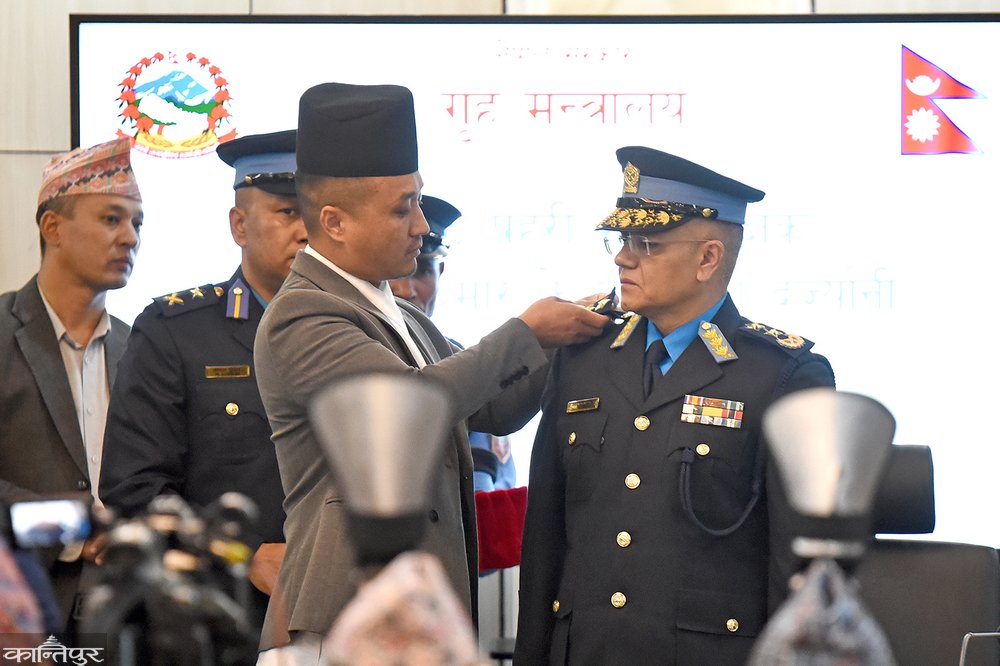
The Balendra Shah-led government has drawn sharp criticism for what many see as an authoritarian maneuver to undermine the independence of Nepal Police.
On November 4, an emergency Cabinet meeting stripped Inspector General of Police Dan Bahadur Karki of his post with roughly 17 months of his tenure remaining, created an ad-hoc IGP-level position of Special Security Adviser to the Prime Minister, and transferred him into it.
The same meeting elevated Additional Inspector General Dr. Manoj Kumar KC—previously ranked lower in the seniority list and heading the Crime Investigation Department—to the top post.
The government has portrayed the move as a routine “change of responsibilities” rather than a removal or punishment, with spokesperson and Education Minister Sasmit Pokharel insisting it was intended to strengthen security advice to the prime minister.
Critics, however, view it as a clear exercise of executive authority that bypasses established legal safeguards on police tenure, due process, and institutional autonomy.
Karki, appointed in late October 2025 on seniority grounds, has challenged the decision in the Supreme Court, arguing it violates the Police Act and Police Regulations, denies him a hearing, and creates an anomalous situation of two officials effectively holding IGP-level rank and authority—one inside the force and one outside it.
The court has issued a show-cause notice to the government and scheduled further hearings, while so far declining immediate interim relief.
Reporting from multiple outlets, including accounts attributed to officials in the prime minister’s secretariat and Police Headquarters, points to underlying tensions.
These include friction over the investigation of Inam Sapkota, a fixer held on money-laundering and banking-related charges, as well as resistance by Karki to certain arrest instructions that police sources described as lacking a solid legal basis.
Allegations of improper contacts have circulated, which Karki has denied; no formal disciplinary or criminal proceedings against him have been announced.
The timing also coincided with earlier police actions against journalists and media outlets following reports of an impending leadership change—actions that further fueled concerns about the use of state machinery against scrutiny.
This episode fits a long-running pattern. Since the restoration of multiparty democracy in 1990 (2046 BS), successive governments have repeatedly intervened in police leadership through political pressure, power struggles, and irregular appointments or exits. The result has been repeated damage to the chain of command, institutional morale, and public credibility of Nepal Police.
Security experts and former officials have noted that creating a new post simply to sideline an incumbent IGP, rather than following transparent, merit-based processes under existing law, reinforces the perception that the force can be treated as an instrument of the ruling circle rather than an impartial enforcer of the law.
Prime Minister Balendra Shah’s government, which took office earlier in 2026 after the Rastriya Swatantra Party’s electoral gains, has faced questions about the consistency of its reformist image with this handling of a key security institution. The ruling party itself has distanced itself from claims that it directed the removal.
While the Supreme Court’s ultimate ruling will clarify the legal boundaries, the manner of the change—an emergency Cabinet decision, an invented post, the absence of a clear public explanation grounded in performance or misconduct findings, and the rapid elevation of a preferred successor—has already illustrated the risks of unchecked executive authority over professional security services.
Until the Police Act and related regulations are amended to lock in transparent, seniority- or merit-based selection and retirement processes free from political discretion, such interventions are likely to continue. For now, the episode stands as a reminder that authoritative control over the police leadership undermines both the rule of law and the institutional stability Nepal’s security apparatus requires.