


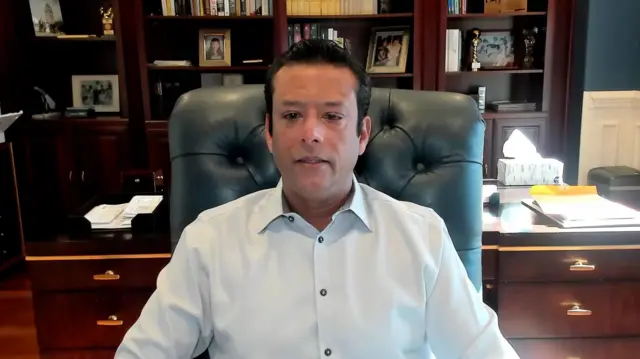
Sajeeb Wazed, son of former prime minister and Awami League President Sheikh Hasina and based in the United States, posted a detailed appeal on Facebook around 3 a.m. Bangladesh time, calling on people to observe a full nationwide lockdown on Thursday.
He framed the action not as a party programme alone but as a collective expression of public concern over security, economic hardship, and what he described as the use of false cases as a political weapon.
In the post, Wazed wrote that while ordinary people can calculate a day’s shop sales, no one is calculating the security of ordinary citizens in a country where the right to vote is under question, the country’s largest party remains banned, and lakhs of people face countless cases.
He warned that anyone could find themselves on a case list tomorrow — whether for land disputes, business rivalry, or old grudges — and described false cases as “the closest weapon” in the hands of the BNP-Jamaat side.
He linked this to rising prices of rice, oil and medicine, factory closures and unemployment, arguing that those in power are more focused on power-sharing than accountability.
The lockdown, he said, would show that people stand with the Awami League and remember who has kicked them in the stomach while filling their own pockets. Emergency services would remain open so no patient is stranded. The post ended with “Joy Bangla” and the hashtag #Bangladesh.
The appeal comes as the country braces for the Awami League’s announced dawn-to-dusk lockdown on 19 November, part of a broader programme tied to demands including the return of Sheikh Hasina, who faces a death sentence in absentia and has signalled plans to return in December. Affiliated organisations including Chhatra League have issued directives supporting the programme.
Authorities have responded with heightened security: paramilitary forces have been deployed, checkpoints set up at Dhaka entry points and in surrounding areas, and surveillance intensified amid intelligence warnings of possible unrest. Police have said the banned party and its wings plan to try to cut off the capital.
Violence and clashes ahead of lockdown
Violence has already claimed lives in the run-up. At least four people were killed in separate incidents over the past two days, according to local reports.
In Narail’s Kalia on Wednesday evening, two BNP-affiliated leaders — Krishak Dal’s Shahinur Sheikh and Jasas leader Sohel Molla — died after an attack on a motorcycle procession; police and BNP sources alleged Awami League activists were responsible. In Faridpur’s Bhanga, a Krishak Dal leader died after burns sustained during a highway blockade.
In Pirojpur, a bus helper was burnt to death while sleeping inside a parked bus that was torched in the early hours of Wednesday.
In Gopalganj’s Tungipara (Hasina’s home area), a police station was stormed and vehicles set ablaze after the arrest of suspected Awami League and Chhatra League activists; additional BGB platoons were deployed.
Homes and offices linked to BNP lawmakers and leaders were attacked or set on fire in places including Gopalganj, while Awami League offices and properties of former leaders were targeted in Sirajganj, Cumilla, and elsewhere.
Crude bomb explosions and bus and vehicle arson have been reported across at least 28 districts in recent days, along with attacks on Grameen Bank branches. On Wednesday night, police reported an arson attack on the family home of former Grameen Bank managing director and former chief adviser Dr. Muhammad Yunus at Panchlaish in Chittagong city.
Separate garment worker protests over wages (demanding a rise from Tk 12,500 to around Tk 30,000–32,000) have led to highway blockades, clashes with police using tear gas and stun grenades, vehicle torchings, and the closure of over 100 factories in Savar, Ashulia and Gazipur areas.
Arrest spree
Police operations have accelerated. In Dhaka over a 24-hour period, authorities reported 565 arrests, including 71 members of the Awami League and Chhatra League, with seizures of crude bombs, torches, drugs and other items; Mirpur Division recorded the highest numbers. Similar drives in Cumilla detained hundreds, including over 100 linked to the banned party.
Additional arrests of Awami League and affiliate activists were reported in Savar-Ashulia-Dhamrai and other areas, often in connection with alleged sabotage, explosives or processions. Earlier compilations cited by Awami League sources claimed nearly 1,900 such arrests nationwide in the first half of November. The Anti-Corruption Commission has also sought Interpol red notices against Hasina, Sajeeb Wazed, Saima Wazed and others in corruption cases.
Prime Minister Tarique Rahman has called for unity among “democratic forces” against what he termed fascist or terrorist elements linked to the banned party and has blamed overseas Awami League leaders for inciting violence. Home Minister Salahuddin Ahmad has warned that those involved in sabotage will be identified and prosecuted. Transport on some routes, including Khulna-Dhaka, has already been disrupted by security concerns.
The prime minister also held a private meeting with the opposition Jamaat-e-Islami Amir, Dr. Shafiqur Rahman, at the parliament building in the evening, following which high-profile Awami League ministers and MPs were arrested in overnight drives by detectives and special police units. The arrestees include former minister Nurul Islam Nahid and former state minister Nazrul Islam Hiru. On the other hand, the houses of five Awami League ministers and MPs were looted and burnt in and various districts.
Wazed’s early-morning post positions Thursday’s lockdown as a non-violent expression of public frustration with the current climate of cases, prices and political restrictions, while authorities prepare for potential disruption and continue the crackdown. The situation remains fluid as the day begins.