

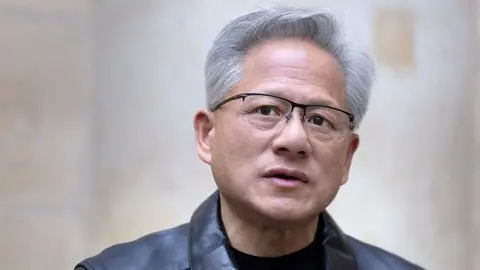
Nvidia, the world’s most valuable publicly traded company and a central supplier of advanced chips for the AI boom, has launched an independent investigation after reports that its longtime CEO, Jensen Huang, had a close relationship with a Chinese businesswoman US intelligence officials believe was working as a spy for Beijing.
According to a New York Times report from late October, American intelligence agencies had been monitoring Alice Huang (no relation to Jensen Huang), a former executive at the Singapore-based data-centre firm Megaspeed. Officials concluded she was acting on behalf of China. Surveillance of her communications eventually led, through a process known as “unmasking,” to the identification of Jensen Huang as the US citizen she was in contact with. Alice Huang has not publicly responded to the allegations. Megaspeed, which has purchased roughly $4.8 billion worth of Nvidia chips over the past two years, has commissioned its own external legal review and said its current leadership takes the matter “extremely seriously.”
Nvidia’s board of directors announced it would examine “all available information” in light of reporting that its founder and CEO “has been the target of a foreign intelligence effort.” The board stated it currently has “no reason to believe that either national security or Nvidia secrets were compromised,” but emphasized that US national and economic security are paramount. It added that Huang “fully supports the review and has committed to cooperating with it” and remains committed to leading the company.
In a separate statement to Nvidia staff, Huang admitted he had been “unfaithful” to his wife, Lori, and apologized for the harm caused to her and their children. “There is no excuse for what I did. I am deeply sorry,” he wrote. Addressing employees, he said: “My responsibility is to serve you and be worthy of your trust. I have fallen short of that responsibility.” He pledged full cooperation with the board’s investigation, affirmed his love for the company and the United States, and said he was “proud and grateful to be an American.”
US President Donald Trump, speaking to reporters, described Huang as “a fine person” who has “done an amazing job for our country,” while noting he had not spoken to the CEO since the news broke. Asked whether he wished he had acted earlier on intelligence briefings about Alice Huang, Trump replied that he did not, calling Huang “an honourable guy.”
China’s foreign ministry has previously dismissed the original New York Times reporting as “groundless speculation” and an attempt to “smear China.” On Chinese social media, the story has generated millions of views, though many users appear to treat it primarily as a marital scandal rather than a national-security matter; state-linked outlets have largely avoided the espionage angle.
Huang, 63, co-founded Nvidia in 1993 after stints at AMD. Born in Taiwan and raised in the United States, he is widely credited with transforming the company from a graphics-chip maker for gamers into the dominant supplier of the high-performance processors that power today’s AI models. Nvidia’s market value stands at approximately $4.5 trillion. The company has been at the center of US-China technology competition, with Washington restricting exports of its most advanced chips to China on national-security grounds.
Technology editor Zoe Kleinman noted that the news has stunned industry contacts. Huang, long regarded as a workaholic perfectionist who has repeatedly pulled Nvidia back from the brink, has now “fallen spectacularly short of his own values,” she wrote, adding that it remains to be seen how employees and the broader market will respond given the potential consequences.
The board’s investigation is ongoing. No findings have been released, and neither Nvidia nor Huang has confirmed or denied the substance of the intelligence allegations beyond acknowledging the personal relationship and supporting the formal review.