


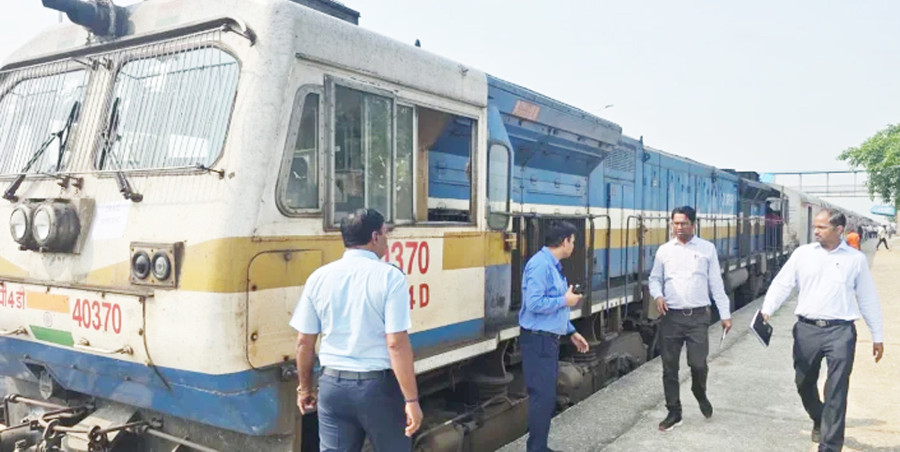
Nepal and India are set to inaugurate a direct passenger train service between Ayodhya in India and Janakpur in Nepal during Prime Minister Balendra Shah’s upcoming visit to India.
Shah is scheduled to travel to India on 22 November, with the service expected to be jointly inaugurated by him and Indian Prime Minister Narendra Modi the following day, according to Nepal’s Ministry of Infrastructure Development.
The two cities hold deep religious significance for Hindus: Ayodhya is the birthplace of Lord Ram, while Janakpur is associated with Goddess Sita. Plans to connect them by rail have been under discussion for years, said Sushil Babu Dhakal, head of the ministry’s Development Assistance Coordination and Quality Division.
“Ayodhya is the birthplace of Lord Ram, and the idea of connecting it to Janakpur by rail has been discussed for a long time,” Dhakal said.
The route covers 604 kilometres, of which only 28 kilometres lie inside Nepal. In the initial phase, the service will use an 18-coach train and operate once a week. A senior ministry official said the train will arrive in Janakpur from Ayodhya one day before its return journey.
As Nepal does not operate its own trains on this section, India will run and manage the service. The frequency may be increased later depending on passenger demand. India has already built the railway infrastructure inside Nepal with grant assistance. “For now, the service will be operated and managed by the Indian government,” the official said. “The operator will bear the costs of using the infrastructure on the Nepali side from Jayanagar.”
Electric trains currently run as far as Jayanagar on the Indian side, while the section inside Nepal is served by diesel trains. During Shah’s visit, Nepal plans to request Indian grant assistance to electrify the Nepali portion of the line.
“Electric trains run up to Jayanagar, but the infrastructure on the Nepali side has not been electrified,” a ministry source said.
Rohit Kumar Bisural, a former director general of Nepal’s Department of Railways, welcomed the initiative, saying it would strengthen cultural ties between the two countries.
“Ayodhya-Janakpur is a religious route. Our cultural ties go back a long way, and a train service will strengthen them further,” he said. Many Nepalis travel to Ayodhya and Indian pilgrims visit Janakpur; a direct service would make the journey faster and more convenient.
Bisural added that both governments should work to turn the service into a regular one and expand Nepal’s rail connections to other Indian cities. “Railway connectivity with other Indian cities should also be expanded. The railway network is being extended towards Bardibas, with plans to eventually connect it to Kathmandu. Both governments should work together to advance that goal,” he said.
Nepal currently runs passenger trains on the 52-kilometre Jayanagar–Janakpur–Bijalpura section. The full Jayanagar–Bardibas line is planned to cover 69 kilometres, with 17 kilometres still under construction. Land acquisition and compensation work is underway on the remaining stretch, and services currently operate only as far as Bijalpura.